Trained for a Crisis That Never Arrives: How Complacency Is Quietly Eroding Emergency Readiness in American Healthcare

There is a peculiar tension embedded in the design of every CPR certification program in the United States. Healthcare workers are trained — rigorously, in many cases — for scenarios that most of them will never encounter during the two-year window their card remains valid. A hospital pharmacist, a long-term care administrator, a clinic receptionist required by their employer to maintain Basic Life Support credentials may complete an entire certification cycle without once placing their hands on a patient in arrest. Then, one unremarkable Tuesday afternoon, the scenario that was always theoretical becomes devastatingly real.
This is the certification shelf life paradox: the skills most critical to human survival are simultaneously the least frequently exercised and the most rapidly forgotten. And American healthcare facilities, despite billions spent annually on training and compliance infrastructure, have not yet found a satisfactory answer to it.
The Neuroscience of Infrequent Practice
Cognitive science offers a sobering framework for understanding what happens to procedural memory when it goes unactivated. Skills acquired through simulation-based training — the foundation of every CPR course — are encoded as motor memory, a category of implicit learning that is durable under conditions of regular repetition and remarkably fragile under conditions of prolonged disuse. Research consistently demonstrates that CPR skill quality degrades measurably within three to six months of initial training, with compression depth, rate accuracy, and hand positioning among the first competencies to deteriorate.
The certification calendar, however, does not reflect this biological reality. A two-year renewal cycle assumes a level of retention that the neuroscience simply does not support. Workers who receive their BLS card in January and face a cardiac arrest in November of the following year may be operating with motor memory that has not been meaningfully reinforced in nearly two years. The card in their wallet says they are ready. Their nervous system may tell a different story.
For facilities that treat certification as a compliance milestone rather than a living competency standard, this gap is not merely theoretical. It has operational consequences — and, in the most serious cases, human ones.
When the Rarity Becomes the Risk
The statistical infrequency of cardiac arrest events in certain healthcare settings contributes directly to the complacency problem. A physical therapist working in an outpatient orthopedic clinic may go years without witnessing a code. A dental hygienist, a radiology technician, a behavioral health counselor — all of whom may be required to maintain current CPR certification — operate in environments where emergencies are rare enough to feel almost hypothetical.
This rarity produces a predictable psychological response. When a skill is never called upon, the sense of urgency that drove its initial acquisition gradually dissipates. The certification renewal becomes, in the minds of many workers, an administrative obligation rather than a professional imperative. They complete the course, pass the assessment, and file the card — without ever genuinely interrogating whether they could perform under the physiological and emotional conditions of a real emergency.
The consequences of this mindset have been documented in incident reports, litigation records, and after-action reviews across the country. Cases in which certified staff hesitated during witnessed cardiac arrests — freezing in the doorway, deferring to colleagues, waiting for the crash cart — are not aberrations. They are a predictable outcome of training cultures that prioritize credential acquisition over genuine readiness.
Reframing the Compliance Conversation
Addressing this paradox requires healthcare facilities to fundamentally reframe how they communicate the purpose of CPR training to their workforce. The conventional compliance framing — obtain the certification, maintain the credential, satisfy the accreditor — is not wrong, but it is incomplete. It answers the question of whether an employee is certified without addressing the more important question of what that certification is actually for.
Facilities that have successfully cultivated genuine emergency readiness cultures tend to anchor their training programs in narrative rather than procedure alone. They use real case studies — drawn from published incident reviews, Joint Commission sentinel event analyses, and documented outcomes from comparable facilities — to make the stakes of skill atrophy concrete and personal. When a healthcare worker understands that a two-minute delay in effective compressions in a case remarkably similar to their own work environment contributed to a preventable death, the renewal course stops feeling like a formality.
This is not fearmongering. It is context — and context is precisely what abstract skills-based training frequently lacks.
Building Readiness Into the Operational Calendar
Beyond narrative reframing, facilities must address the structural problem at the heart of the paradox: the gap between certification events. A two-year renewal cycle is a regulatory floor, not a readiness ceiling. Organizations that treat it as the latter are accepting a level of skill degradation that their accreditation status does not reflect.
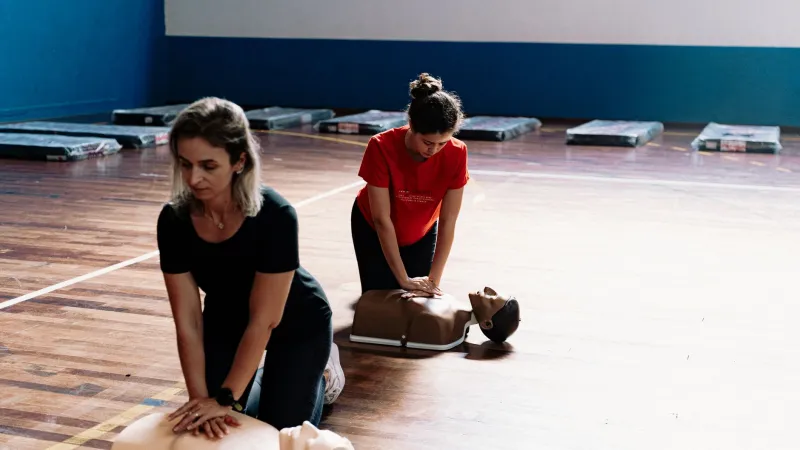
Practical interventions are available and increasingly well-supported by evidence. Brief, high-frequency simulation exercises — sometimes called "CPR pit stops" or skills checkpoints — can be integrated into existing staff huddles, unit meetings, or shift transitions with minimal disruption to workflow. These micro-practice sessions, lasting as few as five minutes, have been shown to substantially improve skill retention between formal certification events.
Similarly, facilities can leverage the growing availability of low-cost manikin feedback devices and digital simulation tools to create self-directed practice opportunities that do not require instructor-led sessions. When the barriers to practice are low and the culture supports regular engagement with emergency skills, the two-year certification cycle becomes a checkpoint within a continuous readiness framework rather than the entirety of it.
The Leadership Dimension
No structural intervention succeeds without visible leadership commitment. When facility administrators, department directors, and clinical supervisors treat CPR competency as a genuine organizational priority — rather than a credentialing checkbox delegated entirely to the education department — the cultural signal is unmistakable. Leaders who participate in skills refreshers alongside their teams, who reference emergency preparedness in the same breath as patient safety metrics, and who allocate protected time for practice rather than squeezing it into already compressed schedules, create the conditions under which readiness cultures can actually take root.
Conversely, when leadership engagement is purely nominal — a signature on a policy document, an annual reminder email — the message received by frontline workers is equally clear: this matters enough to require, but not enough to prioritize.
From Credential to Competence
The certification shelf life paradox will not be resolved by changing renewal intervals alone, though more frequent formal assessments would certainly help. It requires a more fundamental shift in how healthcare organizations understand the relationship between a credential and the competency it is meant to represent.
A CPR certification card is, at its best, a snapshot — evidence that on a specific date, in a controlled training environment, a healthcare worker demonstrated the ability to perform life-saving skills to a defined standard. What happens to those skills in the months that follow is entirely a function of what the facility, the team, and the individual worker choose to do with them.
The emergencies that test those skills do not announce themselves. They arrive without warning, without rehearsal, and without regard for the expiration date printed on a laminated card. The facilities and individuals who treat every day between certifications as an opportunity to stay genuinely ready — rather than merely compliant — are the ones most likely to respond effectively when that unremarkable Tuesday afternoon arrives.
At CPR Healthcare Training Academy, we believe that certification is not the destination. It is the foundation. Building on it, consistently and deliberately, is what transforms a trained healthcare worker into a prepared one.