Why Your Staff Passes the CPR Exam and Forgets the Skills by Summer: The Retention Crisis Facilities Are Finally Confronting
There is a quiet assumption embedded in the way most American healthcare facilities manage CPR certification: that passing the exam means the skill is owned. An employee completes their biennial recertification, earns a card, and returns to the floor. The administrator checks a compliance box. Two years pass. The cycle repeats.
But a substantial and growing body of evidence suggests that this assumption is dangerously incomplete. Studies examining psychomotor skill retention in healthcare workers consistently find that measurable degradation in CPR technique—compression depth, rate, hand placement, ventilation timing—begins within weeks of initial training. By the six-month mark, retention rates for critical procedural components can fall by as much as 60 percent compared to post-training performance benchmarks. The certification card has not expired. The competency, however, has quietly eroded.
Understanding why this happens—and what facilities can realistically do about it—requires looking beyond the renewal calendar and into the neuroscience of how the human brain encodes and sustains procedural memory.
The Neuroscience Behind the Forgetting Curve
Hermann Ebbinghaus identified the forgetting curve in the nineteenth century, and modern neuroscience has only refined what he observed: without reinforcement, the brain deprioritizes information it does not regularly access. This is particularly relevant for procedural skills, which depend on the consolidation of motor memory through repeated physical execution.
CPR is not a cognitive task in the way that reading a protocol or interpreting a monitor is. It is a physical sequence that must be executed with precision under conditions of acute stress. The brain encodes these motor patterns through practice and repetition, storing them in procedural memory systems that are distinct from declarative memory. When those physical rehearsals stop—as they do the moment a certification course ends—the neural pathways supporting the skill begin to weaken.
What makes this particularly problematic in healthcare settings is the compounding effect of stress on memory retrieval. Research consistently demonstrates that acute stress impairs access to procedural memories that have not been sufficiently reinforced. A nurse who could perform textbook-quality compressions in a low-stakes classroom environment may find that retrieval falters when an actual cardiac arrest unfolds in a busy emergency department. The certification captured a moment of competence. It did not guarantee durability.
What the Six-Month Benchmark Actually Means for Facilities
The six-month retention threshold is not merely an academic data point. For a facility employing fifty nurses and medical assistants, all of whom completed their BLS recertification in January, it means that by July, a significant portion of that workforce may be operating with substantially degraded CPR proficiency—while remaining fully credentialed on paper.
This gap between documented compliance and actual readiness is a liability that extends across legal, clinical, and ethical dimensions. Facilities that rely exclusively on the two-year renewal cycle are, in effect, treating certification as a proxy for competence rather than a baseline from which competence must be actively maintained.
The question is not whether this decay is occurring. The evidence on that point is clear. The question is what administrators, educators, and clinical leaders are willing to do about it within the practical constraints of staffing, budget, and time.
Spaced Repetition: The Evidence-Based Alternative to Annual Refreshers
One of the most well-supported interventions in the learning science literature is spaced repetition—the deliberate distribution of practice sessions across time rather than concentrating training in a single intensive block. Applied to CPR skill maintenance, this approach replaces the model of one large training event every two years with shorter, more frequent exposures to the core procedural elements of resuscitation.
Facilities implementing spaced repetition protocols have structured these interventions in various ways. Some use brief monthly manikin stations positioned in staff break rooms or nursing lounges, allowing employees to complete a five-minute compression and ventilation drill during off-peak hours. Others integrate quarterly skill checks into existing department huddles, using a standardized checklist to assess compression rate and depth without removing staff from their units for extended periods.
The key principle is interval timing. Spaced repetition is most effective when the gaps between practice sessions are calibrated to occur just before significant forgetting would otherwise take place. For CPR motor skills, this typically suggests reinforcement intervals of four to eight weeks during the first six months following initial certification, with less frequent but still consistent practice thereafter.
Simulation Drills as a Retention Tool, Not Just an Assessment
Many facilities have historically used simulation primarily as an evaluation mechanism—a way to assess whether staff can perform CPR correctly under observed conditions. Increasingly, however, training directors are recognizing simulation's potential as a retention tool in its own right.
High-fidelity simulation drills that incorporate realistic scenario elements—unexpected cardiac arrest during a routine procedure, a patient found unresponsive in a bathroom, a code called in a hallway without immediate access to a crash cart—activate the stress response in a controlled environment. This matters because skills practiced under mild-to-moderate stress conditions tend to be more accessible when genuine stress is encountered later. The brain, in effect, rehearses not just the physical sequence but the cognitive and emotional context in which it must be retrieved.
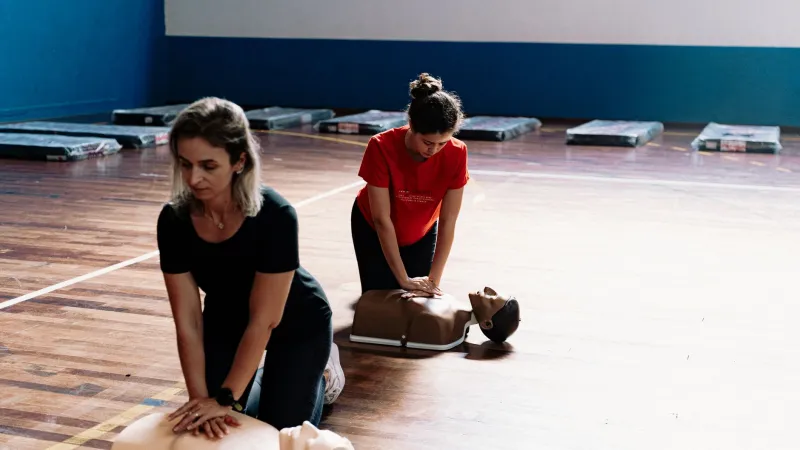
Facilities that have integrated quarterly or even monthly low-intensity simulation drills—sometimes called "code walk-throughs" or "micro-simulations"—report both improved staff confidence and measurable improvements in compression quality metrics during actual resuscitation events. These drills do not require the full infrastructure of a simulation center. A manikin, a timer, and a trained observer are sufficient to deliver meaningful reinforcement.
The Role of Team-Based Training in Sustaining Individual Skills
Another dimension often underemphasized in facility training programs is the social and collaborative dimension of CPR performance. Resuscitation in a clinical setting is almost never a solo act. It involves team communication, role assignment, rotation of compressors, and coordination with pharmacy, respiratory therapy, and physician leadership. Training that isolates individual skill performance without rehearsing team dynamics misses a critical component of real-world readiness.
Facilities that have shifted toward team-based CPR reinforcement activities—structured debriefs following actual resuscitation events, interprofessional simulation drills, and role rotation exercises—report improvements not only in technical performance but in response time and communication clarity during codes. These team-based experiences also create informal accountability structures: when colleagues practice together regularly, individual skill maintenance becomes a shared professional norm rather than a solitary compliance obligation.
Rethinking the Facility's Role in the Certification Lifecycle
The two-year recertification cycle mandated by certifying bodies represents a regulatory floor, not a clinical ceiling. Facilities that treat it as the complete answer to CPR competence are accepting a level of risk that the evidence does not support.
The most forward-thinking healthcare organizations in the United States are beginning to treat CPR skill maintenance the way they treat hand hygiene compliance or infection control protocols—as an ongoing operational responsibility rather than a periodic administrative task. They are investing in low-cost, high-frequency reinforcement mechanisms. They are building simulation into existing workflows rather than treating it as an interruption to them. And they are measuring retention, not just certification status.
For facilities ready to move beyond checkbox compliance, the path forward is not complicated. It requires acknowledging that the brain forgets, that motor skills decay, and that a card on file is not the same as a skill in hand. From that honest starting point, the interventions are practical, scalable, and—when implemented consistently—genuinely effective.
At CPR Healthcare Training Academy, we believe that certification is the beginning of a competency journey, not the end of one. The science of retention demands nothing less.